

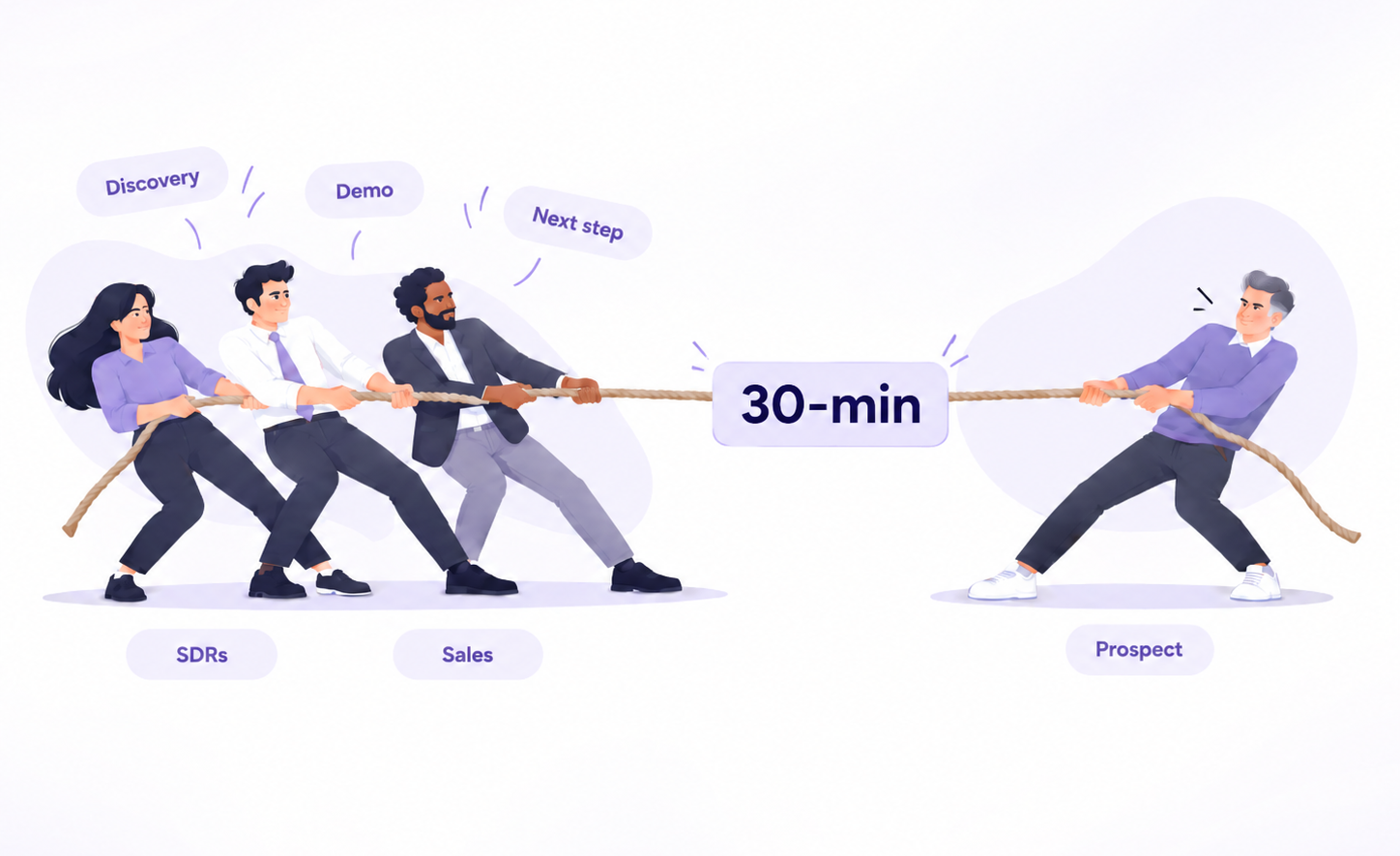
Earning meetings was my job for most of a decade. Cold calls, emails, research, even personalized cartoons. Whatever it took to get on the calendar.
Then you get one. Thirty minutes, Thursday at 2:00pm.
Thirty minutes is four jobs
An SDR asks for fifteen, because the goal is to lower the bar enough to get a yes. Sales almost never does. Thirty is the block, because thirty is roughly what the conversation needs.
It still has to carry four jobs. Build rapport. Run discovery. Convey enough value to matter. Earn the next conversation.
And the rep walks in not knowing which version of the call it will be. Some buyers open by asking what you do and why you reached out. Others will talk about their business for twenty minutes if you let them. Reading that in the first ninety seconds and adjusting is most of the skill.
Often nobody in the meeting chose it, either. An SDR booked it, the buyer said yes partly to stop the emails, and the rep inherits a calendar invite with no context and thirty minutes to make it matter.
But the length of the meeting is not the binding constraint. What the buyer believes they are agreeing to is.
Nobody is really asking for thirty minutes
A finance leader who accepts a thirty-minute meeting is not agreeing to thirty minutes. They know what follows. The recap email. The follow-up. The check-in. A second rep added to the thread. The call six weeks later that opens with “just circling back.”
The meeting is the cheap part. The sequence attached to it is the real price.
A leader who declines a first conversation is often not saying the topic is irrelevant. They are declining everything that comes with it.
That distinction matters, because it means a better email is not the fix. The email was never the objection.
They are already being asked constantly
Finance leaders are not hostile to vendors. They are worn down by volume.
“Recruiters, salespeople - somehow they have all my cell phone information. Some of them even have my work phone. That’s just annoying.”
— Controller, Mid-Market
Against that, thirty minutes with an unfamiliar company is not a small ask. It is a bet that this one will be different from the last ten.
What earns the time
Most of the people receiving those emails are not in the market at all.
Professor John Dawes of the Ehrenberg-Bass Institute, working with the LinkedIn B2B Institute, put a number on it: at any given time, as much as 95% of business buyers are not in the market for a given product or service. The mechanism is simple. Companies replace things like banking, legal, telecom and software roughly every five years, which puts about 20% in market in a given year and roughly 5% in a given quarter.
So a well-built list of the right titles at the right companies is still mostly people whose purpose has not arrived yet.
In recent conversations with finance and accounting leaders, the ones willing to spend time were not won by a clever subject line. They had a reason of their own.
“I’m not just out there browsing. I’m browsing for a purpose.”
— Senior Director, Financial Systems & Transformation, Enterprise
That purpose exists before any vendor shows up. Someone is replacing a system, absorbing an acquisition, cleaning up a close process or trying to understand what has changed in a category since they last looked.
The second thing they asked for is simpler than most marketing assumes. They want to see the product.
“It would be nice to cut the time spent meeting with vendors and have official demos that answer key questions.”
— VP Global Controller, Enterprise
Not a narrative about the category. Not a maturity model. The product.
The give and the get
A good thirty-minute call is not a product pitch. The goal is the next conversation.
But pure discovery is one-sided, and most reps feel it. Asking a stranger fifteen questions about their close process while offering nothing back is not a conversation. It is an intake form. So the rep gives something.
The trouble is what they have to give. On a first call, with no context and no relationship, the only currency reliably on hand is the product. What it does. Who uses it. How it works. Ten minutes go there, not because the rep planned it, but because it is the thing they can trade.
The best reps have better currency. They talk about a specific customer with a specific problem and what actually happened, including the part that did not go well. The product gets teased rather than explained, because the story carries it and the buyer can tell the difference.
That currency is expensive. It comes from tenure, from sitting through implementations, from losing a few deals and remembering exactly why. A rep two months in does not have it, and no amount of enablement content is a substitute. Most teams cannot staff every first call with the person who does.
So the default holds. The rep spends a third of the meeting on the part the buyer could have handled alone, and the buyer spends it listening to an overview instead of talking about their business.
A different thirty minutes
The answer is not a longer meeting. It is a better trade.
A buyer who already knows roughly what the product does, has formed an early opinion and has chosen to keep going changes the currency. The tenured rep gets the whole thirty minutes for the stories only they can tell. The newer rep gets to start somewhere better than an overview.
Discovery stops feeling extractive when the rep has something real to put on the table.
Sellers are not the problem here. They are spending the hardest thing in the job to get - a live conversation with a real buyer - on the part that buyer could have handled alone. Give that part back, and thirty minutes is plenty.