

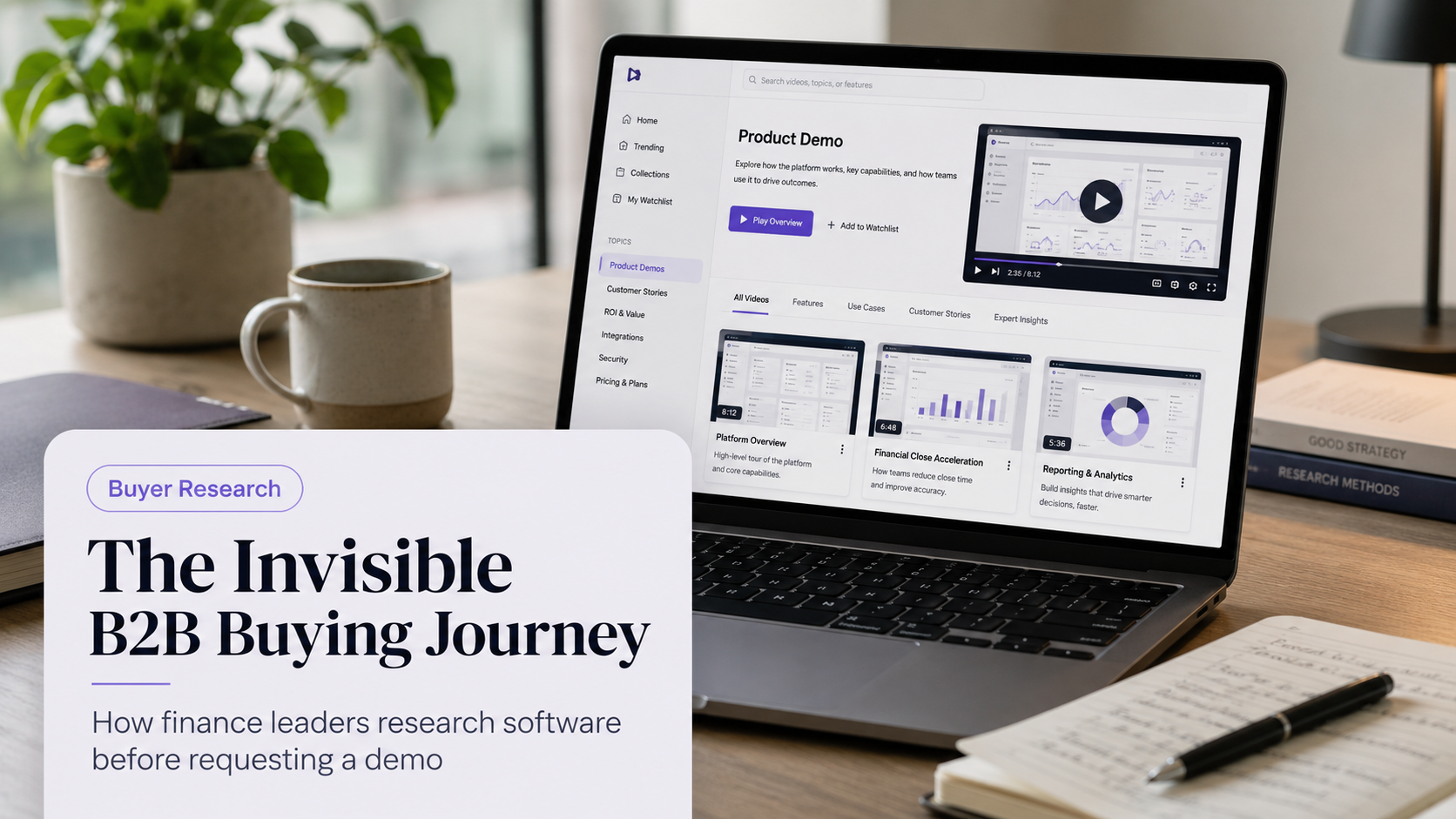
Over the past few months, I’ve spoken with a handful of finance and accounting leaders involved in recent software purchases. I wanted to understand what happened before they spoke with a vendor: where they started, how they narrowed the market and what they wanted to learn before requesting a demo.
I expected to hear about Gartner, G2, peer recommendations and AI. All of those came up. But so did YouTube.
These leaders were actively searching for product demonstrations so they could understand what a platform did before committing to a sales conversation.
One finance leader told me:
“I’ll go to YouTube to see if I can find any videos. I’ll also go to Reddit for commentary, and then I’ll compare the options against each other.”
Another starts with Gartner, G2 or an LLM, talks to people in his network, narrows the category to three to five vendors and then looks for demos. His alternatives are meeting with every vendor - or searching YouTube and hoping something useful exists.
These were qualitative conversations, not a statistically significant study. But broader research supports the behavior. Gartner found that 67% of 646 B2B buyers surveyed preferred a rep-free experience. Green Hat and 6sense found that buyers across 632 APAC organizations were already about 60% through the journey when they engaged vendors.
Buyers are doing meaningful work before the demo request. My conversations helped reveal what some of it looks like.
1. Buyers build the shortlist before sales knows it exists
The first sales conversation is often not the beginning of the buying journey.
By then, a buyer may have researched the category, reviewed analyst sites, asked peers what they use and narrowed the market to a few serious options. A vendor can be eliminated before its sales team knows an evaluation is happening.
Getting onto the shortlist depends on whether a buyer can quickly understand what your product does, who it is for and why it deserves more of their time.
A homepage full of broad benefits may create interest. It rarely creates enough product understanding on its own.
2. Buyers piece together the answer across multiple sources
An LLM may explain the category. Gartner or G2 may identify established vendors. A peer can validate what has worked. Reddit offers candid commentary. YouTube gives the buyer a chance to see the product.
That matters because nearly every B2B software company says its product is modern, easy to use and powered by AI. When everyone makes similar claims, buyers need other ways to separate them.
One executive told me a product video would be valuable when it was:
“Substance-packed versus a bunch of fluff.”
He wanted to understand where each product was strongest, what implementation looked like and what other buyers had experienced.
A customer logo does not answer those questions. Neither does an overview that talks around the product without showing it.
3. YouTube has become an unofficial B2B demo library
Once buyers identify a few credible options, they want to see the actual product: what it looks like, how a workflow operates and whether they can imagine their team using it.
Some vendors publish strong product content. Others publish almost none. And nearly every vendor’s YouTube page feels like a scavenger hunt.
A buyer might find an old webinar, customer interviews, event recordings and short feature clips. The useful demonstration may be buried 20 videos down, or may not exist.
Sometimes the best walkthrough comes from a partner, reseller, customer or independent creator. I have found third-party demonstrations attracting as many views as some of the strongest explainer videos on the company’s own channel.
The buyer does not necessarily care who uploaded it. They are simply trying to see the product.
If buyers are willing to hunt through YouTube for an unofficial demonstration, the demand for product understanding already exists.
4. Marketers can see activity, but not always the context
Sophisticated marketing teams are not completely blind.
First-party analytics, account-identification platforms and IP-based tools can show that an account visited the website, returned or spent time with specific content.
YouTube is not an analytics black box either. Channel owners can see views, watch time, audience retention, traffic sources, search terms and broad audience patterns. Paid advertisers can also measure engagement and conversions.
That data is useful, but it does not naturally tell a vendor that an organic viewer was a VP of Finance at a 1,500-person company, which workflow mattered, what remained unanswered or whether that buyer would be open to a conversation next quarter.
Google also applies aggregation and privacy checks designed to prevent advertisers from identifying individual users.
The journey extends beyond properties the vendor owns.
A finance leader may discover a company through an LLM, visit its website, watch a partner demo on YouTube, check Reddit and share the video with a colleague.
Some activity may be detectable. Much of the buyer context is not.
When the best video belongs to a third party, the vendor may not even own the basic engagement data.
The activity is not entirely invisible. The buyer’s questions, reactions and timing often are.
5. Buyers want control over when sales enters the process
Rep-free does not mean sales-free.
Buyers still need sellers for pricing, validation and implementation planning. They simply want more control over when the conversation begins.
Independent sources can feel safer because buyers can explore without wondering whether one click will trigger a call, an email and three follow-ups from an SDR.
Most B2B marketing flywheels are designed to bring people onto the company website. That still matters. But buyers already move between AI tools, analyst reports, peers, review sites, Reddit, YouTube and third-party demonstrations.
What if buyers could learn about a product from an independent source where they felt free to explore, share honest feedback and indicate whether they wanted to speak now, later or not at all?
What if the vendor could receive structured, permissioned insight into what resonated, what remained unclear and whether there was a reason to follow up?
That would provide something website and YouTube analytics generally cannot: not just evidence that activity happened, but context around the person and the interest behind it.
What should B2B marketers do about it?
The answer is not to gate every product video so you can collect another email address. That may simply push the buyer back to YouTube.
A better starting point is to make the product easier to understand.
Publish an official overview that shows the actual platform. Organize product content by use case and buyer question. Explain who the product is (and is not) built for. Make implementation and customer-fit information easier to find.
Most importantly, give buyers options beyond “Book a demo.”
A buyer should have a low-pressure way to say the product is relevant but the timing is wrong, they need clarity on one workflow or they would be open to a conversation later.
The pre-demo journey is not invisible because marketers have no data.
It is invisible because the most meaningful parts happen across disconnected channels, and the buyer’s questions, reactions and timing rarely travel back to the vendor.
Buyers are already researching, watching, comparing and forming opinions.
The opportunity is to create a better experience for them, and capture more of the meaningful signal happening before they raise their hand.